Patriotism as sacrificial ideology
Journey to the End of the NightPatriotism as sacrificial ideology is the novel’s account of how a nation’s language of love and honor can make the deaths of ordinary people seem necessary, glorious, and even freely chosen. Its central contradiction is that those who proclaim the sacred duty of sacrifice do not bear its consequences equally: the poor are counted, watched, and sent toward the front, while civilian and official life continues around them. Through Ferdinand Bardamu’s rejection of the war and his skeptical account of patriotic history, the novel exposes heroism as both a public performance and a means of organizing mass death.
From patriotic fervor to collective violence
The creed first appears as a social atmosphere that grows more intense as the war proceeds. On returning to Paris, Bardamu finds civilians increasingly caught up in the idea of glory. Soldiers’ experience gives the home front a model for its own performance of courage, while mothers alternate between the roles of nurses and martyrs and receive official certificates. The circulation of patriotic feeling therefore extends beyond the battlefield: it becomes a set of public roles through which civilians can display endurance without sharing the soldiers’ immediate exposure to death.
Bardamu’s relationship with Lola brings that atmosphere into intimate life. Lola is a nurse who serves France with enthusiasm, but the war stands between her and Bardamu because he has come to regard its slaughter as absurd. He is prolonging his convalescence and dreads returning to the front; she belongs to a culture that treats patriotic service as admirable. Their attachment does not resolve this conflict. Instead, their different responses show how a national cause can enter a private relationship and make affection coexist with incompatible beliefs about sacrifice.
The public language surrounding the war is also accompanied by a broad collapse of trust. Bardamu sees organized charitable “days,” newspaper claims, posters, and patriotic slogans amid a city where lying has become ordinary and truth difficult to find. In his account, the war’s public culture does not merely praise sacrifice; it fills daily life with claims and performances that make the praise difficult to separate from deception. Lola’s limited French consists of patriotic phrases, while Bardamu doubts the impressions she tries to create about America. His distrust is thus directed not only at military orders but at the surrounding verbal world that presents the war as meaningful and admirable.
Refusal and the anonymity of the dead
Bardamu makes his opposition explicit in his conversation with Lola. He refuses to describe himself as grieving for or resigned to the war: his position is rejection, grounded in the fact that he does not want to die. Lola treats that refusal as cowardice and madness, invoking the expectation that a person should support the country when it is in danger. Their disagreement exposes the moral pressure built into patriotic language: self-preservation is recast as a defect, while willingness to die is offered as proof of loyalty.
Bardamu answers by challenging the promised meaning of military death. He asks whether Lola can name soldiers killed in the Hundred Years War and argues that, to the living, those dead are anonymous and forgotten. The contrast is between the grand public account of sacrifice and the negligible place ordinary soldiers occupy in memory. His conclusion is not that individual deaths receive lasting honor, but that the men may have died for nothing. The argument makes remembrance itself part of the dispute: patriotic culture celebrates the collective dead while failing to preserve the identities that would give their deaths personal meaning.
His fear is not presented as a reasoned position detached from experience. Bardamu recalls entering the war without imagining its horror and then finding himself caught in collective killing. At the hospital, the separation between battlefield violence and patriotic administration proves thin. Wounded men are addressed gently, but the procedures around them—papers, tags, and precautions—make them feel counted and prepared for return to the front. Bardamu reads the medical institution’s reassuring manner against the destination it is preparing them to reach. The system can speak softly and still direct a frightened soldier back toward death.
Class, recruitment, and the uses of honor
The novel connects patriotic sacrifice to social inequality. Bardamu argues that the poor are treated differently when they transgress: petty theft attracts severe condemnation because it signals poverty and implies a challenge to the social order. Yet when the war needs bodies, even a man who has stolen food can be forgiven and returned to the army. Bardamu is told that his offense will be overlooked in consideration of his family’s honor, but he rejects the idea that family honor can protect him from bullets or restore him after death. The change in official judgment reveals the practical priority beneath the moral language: conduct that once marked a poor man as unworthy can be pardoned when he is needed as a soldier.
This contrast sharpens Bardamu’s account of who benefits from patriotic feeling. He warns that when the powerful begin professing compassion for the poor, that affection may signal an intention to use them. In his telling, the war turns the language of concern into an instrument of mobilization: the people are addressed as valued members of the nation just as they are being prepared to die for it. The supposed honor of service does not undo the unequal conditions that make the poor expendable; it gives those conditions a more flattering name.
Bardamu extends the argument into a history of mass enlistment. He presents the French Revolution’s political education, newspaper reading, voting, and patriotic appeals as conditions that helped produce citizen-soldiers who marched to fight. He contrasts these volunteers with Dumouriez, who deserted when money mattered more to him, and describes the later system as one in which heroes could be produced in large numbers at little cost. The sequence is deliberately provocative: the language of emancipation and popular participation can lead not only to political agency but also to a new kind of military obligation, in which the people help authorize the cause for which they are sent to die.
Institutional praise and the making of heroes
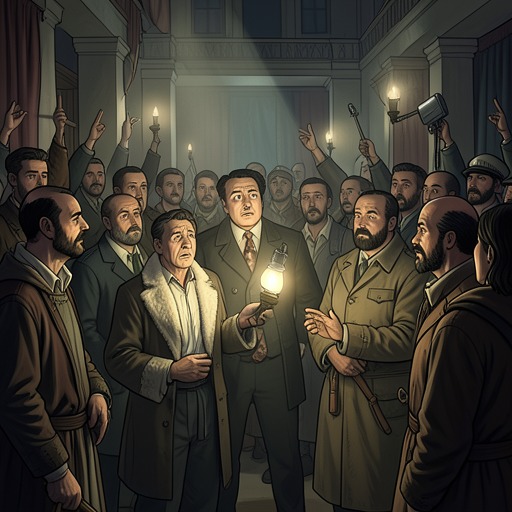
The hospital offers a concentrated scene of patriotic persuasion. A newly promoted major addresses the wounded, presenting France as a woman who has trusted them and expects her sons to avenge an aggression and recover every part of her territory. He promises the soldiers the resources of medical science, but frames recovery as preparation to resume their place in the trenches. His speech links care to renewed service: treatment is offered within a system whose stated destination is the front.
The scene’s human details complicate the speech’s ceremonial tone. The soldiers stand at attention while the doctor speaks; behind him, a nurse cries because her fiancé has gone to the navy. Her grief is real, but it sits beside the institutional expectation that the wounded will return to duty. Bardamu and his comrades recognize that death follows them even into the hospital, though their fellow soldiers do not all interpret the scene as he does. To Bardamu, the doctor’s appeal is not encouragement but an insult, because its language of trust and duty obscures the lethal purpose of the procedures surrounding them.
The novel places the same logic in an academic register when Professor Bestombes identifies patriotism as the highest concept for arousing altruism and compelling its public display. He joins patriotism to glory and argues that soldiers under fire instinctively abandon self-preservation for the nation. The claim turns a political expectation into an asserted truth of the heart, while making intelligence appear obstructive. Set against Bardamu’s fear and refusal, the professor’s theory reveals the work required to present self-preservation as a lesser impulse and sacrifice as the soldier’s natural fulfillment.
Historical reach and critical meaning
Bardamu’s history of patriotic mobilization reaches its emblematic point at the Battle of Valmy. He describes ragged, impassioned volunteers going to fight the King of Prussia for a patriotic fiction, and presents Goethe’s arrival as an encounter with a new historical era. The episode marks the emergence of a system capable of producing heroes on a mass scale. In this account, the flag takes the place of an older religious allegiance, while collective identity gives military death an enlarged political meaning.
The history does not stand apart from Bardamu’s immediate experience. It supplies a genealogy for the rhetoric that he encounters in hospitals and on the home front: civic participation and national belonging can be made to serve the mobilization of ordinary people. The movement from political ideals to military sacrifice is not presented as inevitable proof of noble purpose. Rather, the language of freedom and glory becomes part of the machinery that persuades people to fight, while those who refuse can be branded cowards or madmen.
The concept’s force lies in the gap between patriotic recognition and individual consequence. France may be invoked as a beloved country, a wounded woman, or a sacred cause, but the soldier’s body remains the thing placed at risk, and his name may disappear from memory. Bardamu’s refusal does not make him secure or admired; it leaves him in conflict with the majority and its definitions of sanity and courage. By setting that vulnerable refusal against official speeches, civilian rituals, historical narratives, and the treatment of the poor, the novel shows patriotism as an ideology that converts unequal exposure to death into an apparent common duty.